
Use cases

Eight missions, one network.

Eight deployments where the endpoints sit behind networks their operators do not control. Each names the relay mode that carries it, the served LAN, seam or exit it uses, and what the people running it get.

Relay modesServed LANsInterconnectExits
Eight scenarios

Different missions. The same reachability problem.

Every scenario starts the same way, with outbound sessions to a relay, and differs in what rides on top: a federated hop between continents, a LAN served from a site, a seam to a partner’s network, an exit to the internet.

01 · Uncrewed systems

A drone’s ground station and the operations centre

The ground station rides cellular or satellite in the field, the operations centre sits behind an office firewall on another continent, and the drone is a member over its radio link to the ground station.

Relay mode
Federated relays, each end on its nearest; the direct path when both NATs allow it.
On top
The drone’s node serves the camera on its own Ethernet as a served LAN.
Outcome
Operations reaches the drone and its camera at their own addresses, and with end-to-end sealing neither relay nor ground station can read the stream.
02 · Mobile fleets

A vehicle fleet on cellular, and its depot

Vehicles change towers, carriers and addresses all day behind carrier NAT. The depot keeps its dispatch server and maintenance machines on a LAN that runs nothing else.

Relay mode
Relay election with two relay paths active, every packet on both under the broadcast scheduler.
On top
Two depot nodes serve the depot LAN; the nearest one carries it and the other takes over within seconds.
Outcome
A lost relay costs no packet, and every vehicle reaches the depot hosts at their own addresses through each handover.
03 · Partners

Two organisations, one mission, two networks

An agency and a contractor each run their own Atlas network, keys and admission. Neither will merge into the other, and each wants to expose only a ground station and a video encoder.

Relay mode
Each network’s members reach the seam host over their own relays, shared or federated.
On top
An Interconnect seam: mapped mode for single hosts, prefix mode for whole networks at real addresses, export lists and signed records limiting both sides.
Outcome
Join two networks, merge neither: either side ends the join by revoking one member, and nothing chains through to a third network.
04 · Remote sites

A site with no public address and a LAN that runs nothing

A pumping station, a substation or a temporary field office sits behind a router someone else manages. Its cameras and controllers cannot run any software.

Relay mode
One shared relay to start, a direct path where the site’s NAT allows it; your own relay beside the hosted ones where policy wants it.
On top
The site’s gateway node serves the /24 with one block; masquerade on, or one static route for real addresses.
Outcome
Headquarters reaches every host at its own address without an inbound rule, a public address or a change on the site’s LAN.
05 · Field teams

Phones and laptops that leave through one exit

A team works from hotel Wi-Fi, cellular and borrowed networks. Its traffic to the internet must leave from one known address, and nothing may leak around the tunnel.

Relay mode
The hosted exit as the full tunnel, ranked by measured round trip; or a private exit at headquarters reached over the relays.
On top
The exit is the far end of the tunnel: it carries the whole default route, with DNS inside the tunnel.
Outcome
The internet sees the exit’s address; on Linux the leak guard keeps the uplinks closed to everything but the daemon’s own traffic.
06 · Closed estates

Relays that never leave your own network

A defence or critical-infrastructure operator cannot route through infrastructure it does not control, and must not appear in any public inventory.

Relay mode
Your own relays, the same package as the hosted ones, pinned by address and key; the hosted relays as extra paths only where policy allows.
On top
Your relays refuse revoked node keys from a revocation file of their own; served LANs and seams work the same over your relays as over ours.
Outcome
Reachability across carrier NAT with every relay inside your boundary and none of them in the public map.
07 · Global fleets

A fleet spread across continents

Nodes in Europe, North America, Asia and Australia all need to reach each other, and a first hop across an ocean is where cellular uplinks and NAT bindings do worst.

Relay mode
Each node on its nearest relay, federated relays carrying the one hop between regions, ranked with the published relay-to-relay matrix.
On top
Presence records sealed to each peer tell a node where its peer is, and nothing anywhere lists who is on which relay.
Outcome
Short first hops everywhere and any-to-any reach. An assistant can read each node’s relay state through atlas-mcp, which edits no configuration.
08 · Phones in the field

A phone that pairs with a ground station over cellular

A new phone on cellular has never been on the ground station’s network. It pairs by QR code, and later joins the ground station’s own Wi-Fi.

Relay mode
A shared relay carries the first handshake to the ground station’s authorizer; on the same Wi-Fi, the local path is found within seconds.
On top
Admission decided on the ground station, by its key file or hook, for a phone it can reach only through the relay.
Outcome
Pairing works behind carrier NAT, and the phone moves to the local path by itself when it comes in range.
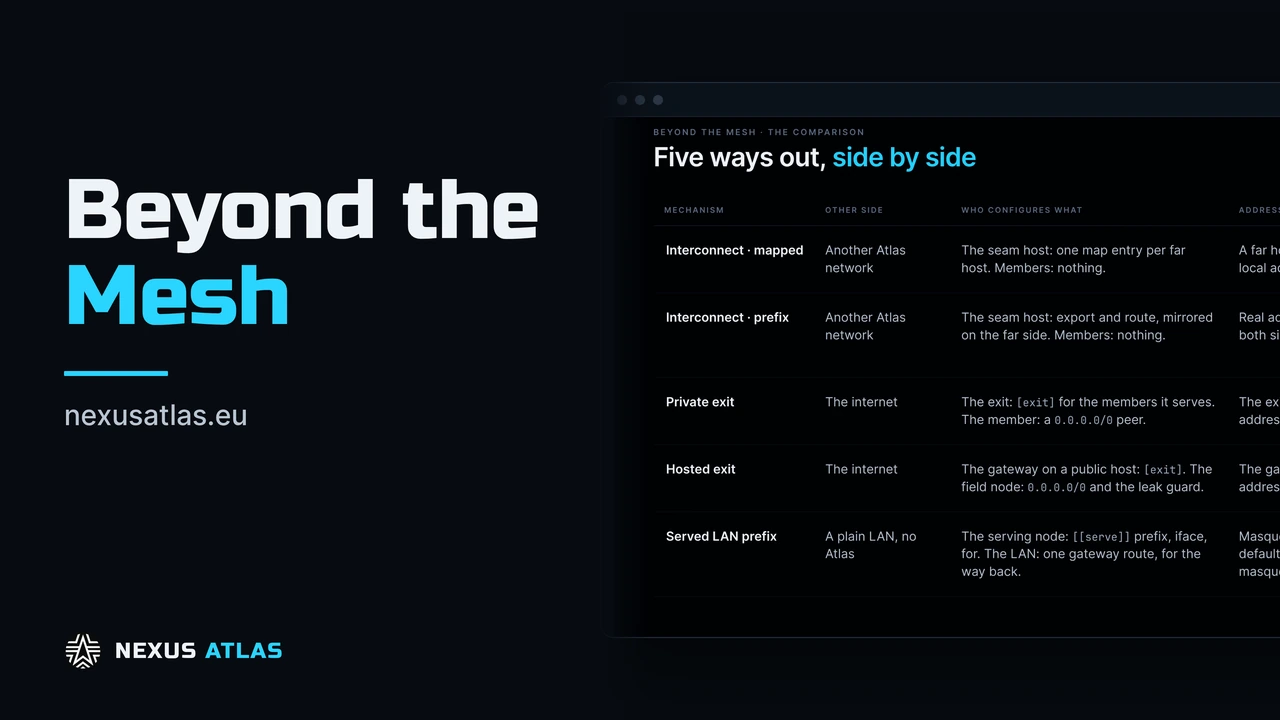
Nexus Atlas: Beyond the Mesh4:08 · plays from YouTube
At a glance

Which mode, which element.

The relay modes are on Relay modes; served LANs, seams and exits over the relays are on Interconnect.

ScenarioRelay modeOn topMechanism on .io
Ground station to operationsFederated relays, direct when allowedServed LAN on the droneTraversal
Vehicle fleet and depotTwo relay paths, broadcastServed depot LAN, two serversServed LANs
Two organisationsEach network on its own relaysInterconnect seam, recordsInterconnect
Site without a public addressShared relay, then directServed site LANServed LAN prefixes
Field teamHosted exit, full tunnelExit, leak guardGateways and exits
Closed estateYour own relays, pinnedRevocation at every relayHop honesty
Fleet across continentsNearest relay, federationSealed presence recordsRelay network
Phone pairing in the fieldShared relay, then the local pathAdmission at the ground stationDirect upgrade
Common operating pattern

Bring up communication before optimizing the route.

Relay-first rendezvous means applications do not wait for a successful hole punch. Better paths appear later without changing the tunnel interface.

01 · Establish

Every endpoint dials outward.

An authenticated outbound relay session creates immediate reachability through ordinary carrier NAT and firewall policy.

02 · Improve

Direct paths are found without interrupting service.

Peers exchange candidates over the working relay route, test the network together, and add a direct path where both access networks permit it.

03 · Extend

What one node serves, every member reaches.

A served LAN, a seam to another network or an exit is configured on one node and learned by the rest of the network over whichever path carries the session.

04 · Combine

Traversal joins the rest of the Atlas path inventory.

Direct and relayed routes sit beside radio, Wi-Fi, mesh, satellite or wired bearers under the same measured scheduler, and operator rules in [policy] decide what each kind of link may carry.

Autonomous systems

Drones, uncrewed ground vehicles, ground stations and command sites using cellular beside radio, mesh or satellite links.

View autonomous systems

Mobile fleets

Vehicles that change towers, carriers and addresses while keeping vehicle-to-command and vehicle-to-vehicle reach.

View mobile fleets

Remote sites

Branches, industrial locations and field infrastructure without fixed public addresses or inbound firewall control.

View remote sites
Scope note. Traversal solves endpoint discovery and reachability for Nexus Atlas nodes and the LANs and networks they serve. Application integration, radio design and mission-specific safety analysis remain part of the wider deployment.
Get early access

Bring us the network you cannot control.

Apply as a pilot partner if you have a deployment ready to test, or start evaluating Nexus Atlas Traversal as a future customer. Tell us enough to understand the endpoints, carriers, regions, and operational constraints involved.

01

Pilot partner

Run an early deployment with direct engineering contact and help shape priorities through real-world feedback.

02

Customer evaluation

Research architecture, security, deployment options, and commercial fit before committing to a pilot.

Already enrolled? Open the console
Early-access applicationUsually answered by the product team

Your application is sent to the Nexus Atlas product team. You can also email office@nexusatlas.io.